

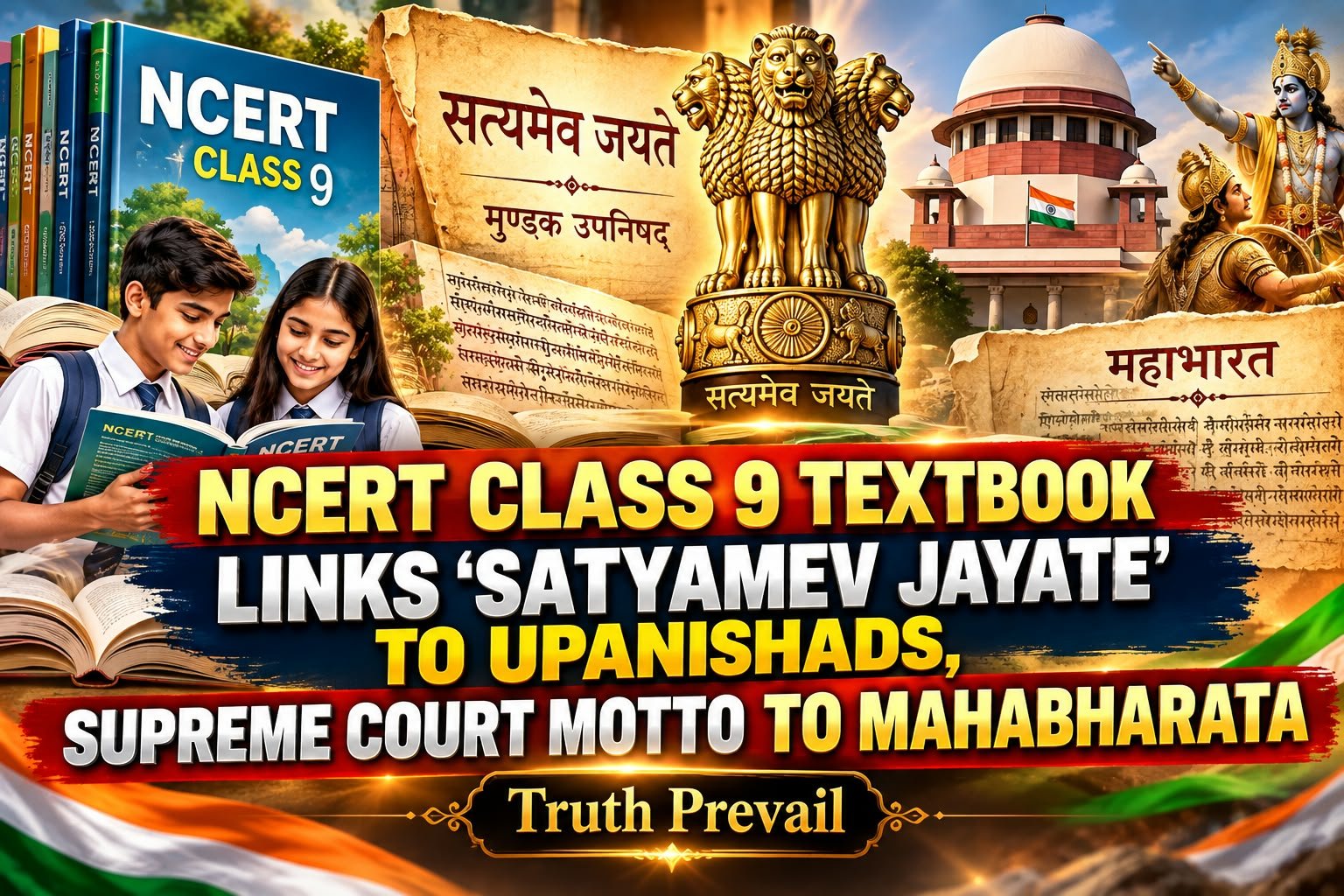
New Delhi, September 30, 2026 : A newly released NCERT Class 9 Social Science textbook links the mottos of several modern Indian institutions with traditional Indian texts, including the Mundaka Upanishad and the Mahabharata.

The textbook, titled ‘Understanding Society India and Beyond – Part 2’, was released on Tuesday, six months after the beginning of the new academic session. Its first part was released in June.
According to the chapter ‘Governance and Public Policy’, India’s national motto ‘Satyamev Jayate’, meaning “Truth alone triumphs,” is drawn from the Mundaka Upanishad. The textbook also states that the Supreme Court of India’s motto, ‘Yato Dharmas Tato Jayah’, has its origins in the Mahabharata.
The textbook explains that after Independence, Indian institutions continued to draw upon traditional ideas and values while adapting them to the requirements of a modern democratic system.
It contrasts the post-Independence adoption of ‘Satyamev Jayate’ with the motto associated with the British-era Order of the Star of India, which was “Heaven’s Light, Our Guide.” According to the textbook, the adoption of ‘Satyamev Jayate’ reflects the continuing importance of Indian ethical values in public life.
The chapter further states that the Supreme Court adopted ‘Yato Dharmastato Jayah’, a phrase taken from the Mahabharata. The textbook explains its meaning as “where there is dharma (righteous duty), there is victory.”
The NCERT material emphasises that these institutional mottos are not merely symbolic expressions. It describes them as representing the core values and ideals of institutions, together with their responsibility to promote good governance.
The release of Part 2 is part of the broader transition to revised Class 9 learning material under the National Curriculum Framework for School Education (NCF-SE) 2023 and the National Education Policy (NEP) 2020.
According to the NCERT-published syllabus, the Class 9 Social Science curriculum covers six chapters across major areas including history, geography, political science and economics.
The textbook’s discussion of institutional mottos places traditional Indian philosophical and literary references within the broader context of governance, public life and democratic institutions.