


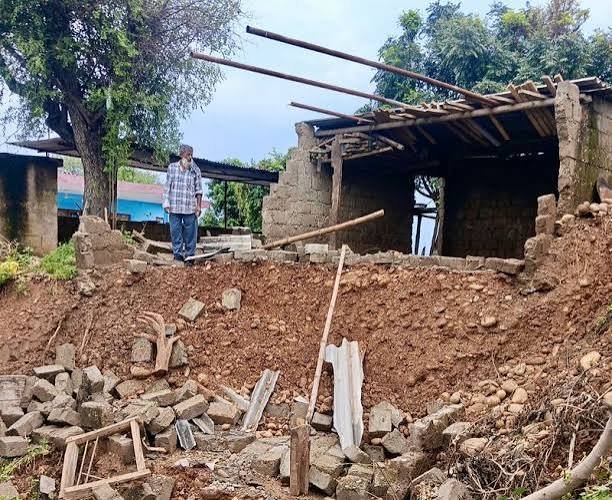
Jammu, June 20, 2026 : Growing incidents of land subsidence across several mountainous districts of the Jammu region have raised alarm among residents and authorities alike, prompting scientific studies and expert assessments to determine the causes behind the increasing occurrence of ground sinking, cracks, and landslides.

Experts and researchers believe that land subsidence incidents reported in districts such as Doda, Ramban, Rajouri, and Poonch are the result of a combination of natural geological conditions and human-induced environmental pressures.
The latest concern emerged from Kotli Kalaban village in Rajouri district, where severe land subsidence caused extensive cracks in the ground, residential houses, and other structures. The situation triggered panic among local residents, forcing the district administration to relocate several affected families after their homes were declared unsafe due to structural damage.
A scientific study conducted by Mohd Mohsin Raza and Yogendra Singh of the Department of Geology, Choudhary Charan Singh University, Meerut, highlighted the role of multiple environmental and geological factors contributing to soil erosion and land instability in Rajouri district.
According to the study, topographical characteristics, land use and land cover (LULC) patterns, and lithology emerged as the most significant contributors to soil erosion susceptibility in mountainous regions. Vegetation cover, soil moisture, rainfall intensity, and soil types were also identified as influential factors.
The research found that land use and land cover accounted for 26 percent, while lithology contributed 10 percent of the total area categorized as highly susceptible to soil erosion. Other contributing factors included aspect (40 percent), rainfall erosivity (18 percent), slope (16 percent), and elevation (3 percent).
The issue gained wider attention following the devastating land subsidence incident in Pernote village of Ramban district in April 2024, where more than 60 houses suffered damage. The administration had to evacuate affected families as the area became increasingly unstable. The incident also caused significant damage to the Ramban-Gool Road, disrupting local connectivity.
A comprehensive study conducted jointly by the National Institute of Hydrology (NIH), Roorkee, and the Indian Institutes of Technology (IIT) Guwahati and IIT Roorkee attributed the Pernote disaster to a combination of adverse geological conditions and extreme weather events.
Researchers identified fault and thrust zones, loose and highly deformed rocks belonging to the Murree Formation, and thick deposits of Quaternary sediments exceeding 20 metres as key geological factors contributing to the instability of the area.
The study further revealed that prolonged and intense rainfall between April 20 and April 24, 2024, saturated the soil and debris cover on steep slopes, ultimately triggering the landslide. The slide resulted in an estimated displacement of 40 metres with a depth of around 12 metres and extended approximately 1,250 metres, reaching the Chenab River.
Importantly, researchers noted that warning signs had been visible years before the disaster. Deep fissures, ground cracks, and land bulging had reportedly been observed in the area as early as 2021, indicating progressive ground movement and instability.
Commenting on the growing trend, Dr. Yudhbir Singh, Associate Professor in the Department of Geology at the University of Jammu, said that the causes of land subsidence vary depending on local geological conditions and human activities.
“In the past, such incidents were rare. However, with population growth and the unscientific exploitation of natural resources, the recurrence of such events has increased,” Dr. Singh observed.
He identified human intervention, geological structures, and lithological composition as the three primary factors responsible for many of the subsidence events being witnessed across the region.
Dr. Singh stressed the need for scientific planning and sustainable development practices to minimize environmental degradation and reduce disaster risks in vulnerable mountainous areas.
“There is a need for course correction. Human activity must be aligned with scientific principles to reduce pressure on the environment,” he emphasized.
As concerns over land subsidence continue to mount, experts are advocating for detailed geological mapping, hazard assessment studies, regulated construction practices, and improved monitoring systems to protect communities living in environmentally sensitive zones of the Jammu region.