


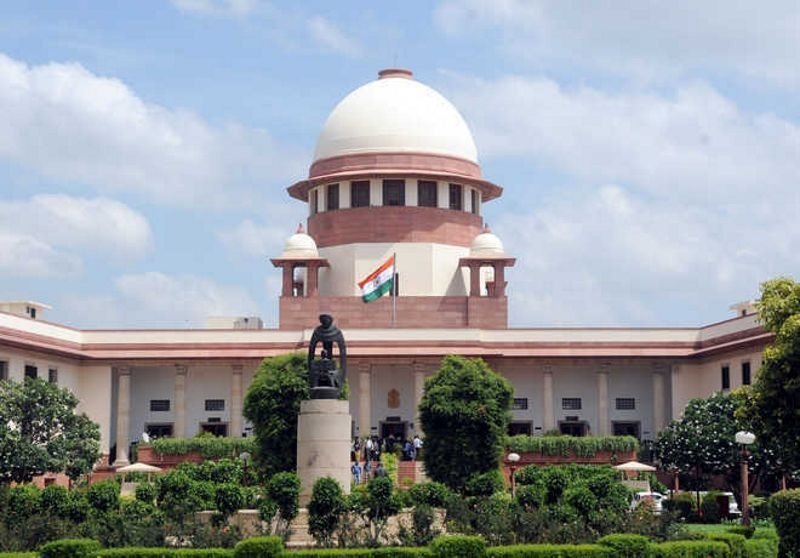
NEW DELHI, August 12, 2026 : The Supreme Court on Wednesday asked States and Union Territories to consider framing or reviewing policies governing the regularisation and demolition of long-standing unauthorised constructions, while declining to impose a uniform framework across the country.

A bench headed by Chief Justice of India Surya Kant, along with Justices Joymalya Bagchi and V. Mohana, dismissed a PIL seeking directions to the Centre and all States to formulate a common policy, observing that the issue largely falls within the policy domain of State governments and local authorities.
SC Rejects One-Size-Fits-All Approach
The bench said ground realities and circumstances differ substantially from one State to another, making it neither feasible nor prudent for the court to prescribe a single policy applicable nationwide.
The court, however, made it clear that States and Union Territories may consider the concerns raised in the PIL while framing new policies or reviewing existing ones.
The bench expressed hope that competent authorities would give due consideration to the issues highlighted in the petition.
PIL Raises Concerns Over Sudden Demolitions
The petition filed by the Centre for Law and Good Governance sought protection for long-standing unauthorised dwelling units, particularly those occupied by economically vulnerable families.
The petitioner pointed to regularisation and settlement schemes adopted in places including Andhra Pradesh, Telangana and Delhi, while alleging that unauthorised colonies and structures in several areas have sometimes been demolished suddenly, without adequate notice, rehabilitation or welfare measures.
The plea argued that demolition is an extreme and irreversible measure and should be governed by a policy balancing enforcement of planning and land-use laws with constitutional protections relating to shelter, livelihood and dignity under Article 21.
Long-Term Occupation Does Not Automatically Make Construction Legal
The petitioner also highlighted cases where residents have occupied properties or colonies for decades, paid municipal and property taxes and received civic services such as electricity, only to later face action on the ground that their structures are unauthorised.
The plea contended that inconsistent approaches by authorities could leave families vulnerable to sudden eviction after several decades.
The court, however, noted that unauthorised construction is not limited to poor or vulnerable residents. Some illegal structures may also be constructed for commercial or profit-making purposes.
CJI Recalls Safeguards Against Arbitrary Demolition
Chief Justice Surya Kant pointed out that the Supreme Court has already laid down safeguards intended to prevent illegal and arbitrary demolitions.
Referring to the court’s human-rights jurisprudence, the CJI noted that the principle flowing from Olga Tellis recognises that a person in settled possession cannot ordinarily be dispossessed without due process.
The court also reiterated that even an unauthorised occupant should ordinarily receive at least 15 days’ notice before demolition, subject to applicable law and judicial safeguards.
Justice Bagchi: Cases Require Individual Assessment
Justice Joymalya Bagchi observed that the issues raised in the petition would often have to be assessed case by case and could not necessarily be resolved through a single policy imposed by the judiciary.
The bench also declined to accept the suggestion that a court-appointed committee could replace the powers and responsibilities vested in State governments and municipal authorities.
It observed that such an approach could draw the judiciary into the executive’s policy-making domain.
Balance Between Law Enforcement and Human Dignity
The Supreme Court’s order leaves the door open for States and Union Territories to examine the need for comprehensive policies dealing with old unauthorised settlements, regularisation, demolition, notice, rehabilitation and alternative accommodation.
At the same time, the court made clear that the mere passage of time or administrative inaction does not automatically legalise an unauthorised construction.
The ruling therefore places the responsibility primarily on State governments and local authorities to strike an appropriate balance between enforcement of land and planning laws and protection against arbitrary displacement, particularly where vulnerable families are involved.