


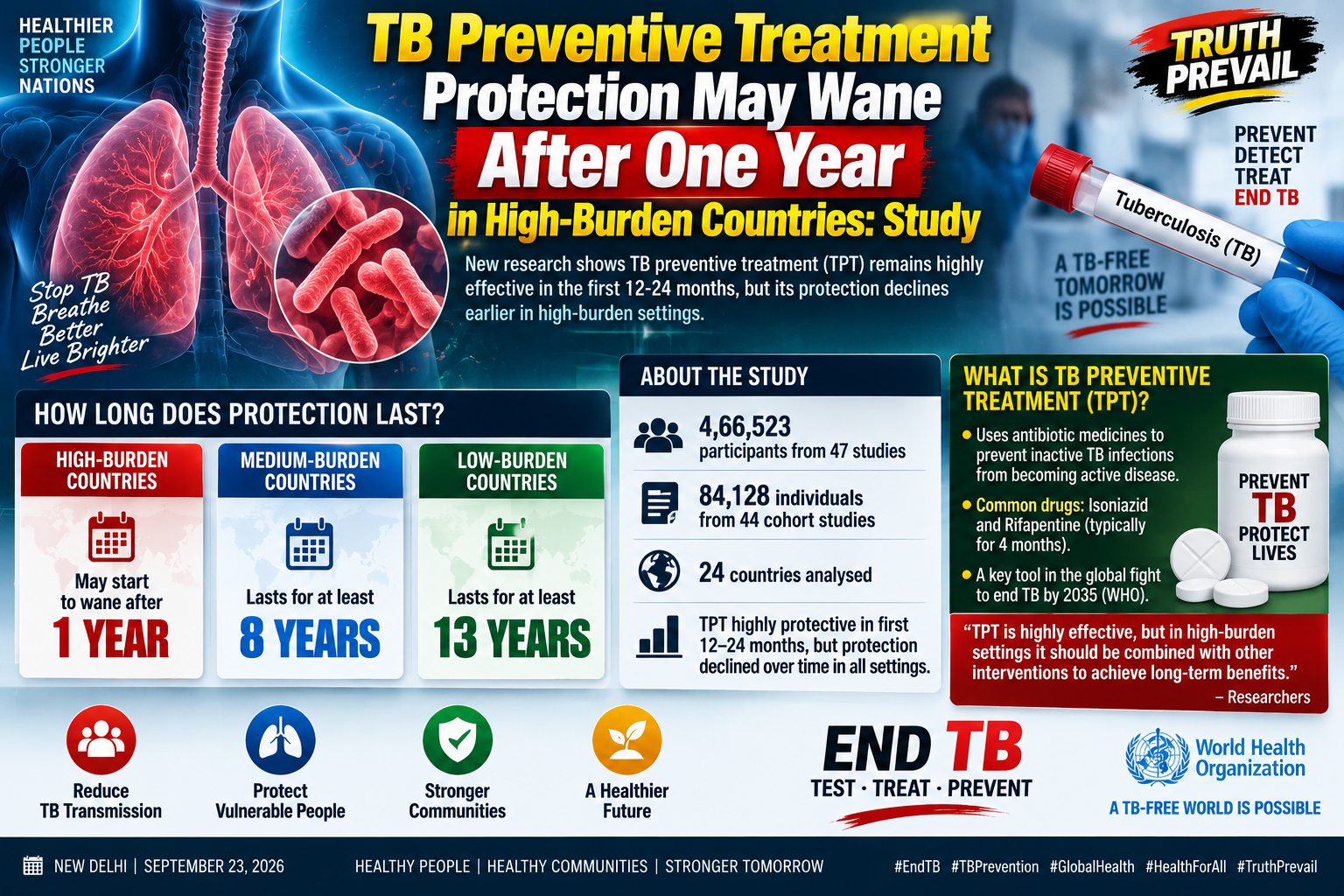
NEW DELHI, SEPTEMBER 23, 2026 ; The protection offered by tuberculosis preventive treatment (TPT) may begin to decline after just one year in countries with a high burden of TB, while its protective effect could last at least eight years in medium-burden settings and 13 years in low-burden countries, according to a study published in The Lancet Respiratory Medicine.

The findings highlight the importance of combining preventive treatment with other measures to tackle ongoing transmission, particularly in communities where TB remains widespread.
Strong Initial Protection
Researchers from Boston University and the University of California, Berkeley analysed TB risk among people with TB infection across 24 countries.
Of 4,66,523 participants identified across 47 studies, the researchers included 84,128 individuals from 44 cohort studies in their analysis.
The study found that TPT provided strong protection during the first 12–24 months across settings with different levels of TB burden. However, the duration of protection varied significantly depending on the underlying burden of TB in the community.
Protection Declines Faster in High-Burden Settings
According to the researchers, TPT remained highly protective during the first year but its effect declined during follow-up in all settings.
The decline was particularly pronounced in high-burden countries, where people remain exposed to continuing community transmission.
In contrast, the protective effect persisted for considerably longer in medium- and low-burden settings.
Why TPT Matters
TPT uses antibiotics to prevent inactive TB infections from progressing to active tuberculosis and is an important component of global TB-control efforts.
Preventive regimens can include medicines such as isoniazid and rifapentine, with some commonly used courses lasting around four months.
The World Health Organization has identified TB prevention and treatment as key components of efforts to end the global TB epidemic by 2035.
Study Calls for a Broader Strategy
Lead author Lauren Linde, an epidemiology doctoral student at Boston University’s School of Public Health, said the study confirmed the established effectiveness of TPT in preventing progression from TB infection to active disease.
However, the rapid decline in protection observed in very high-burden settings indicates that TPT should not be relied upon in isolation, according to the researchers.
They suggested combining preventive treatment with additional interventions designed to reduce ongoing community transmission, particularly in countries where TB incidence remains high.
Key Findings
- 24 countries included in the analysis
- 44 cohort studies examined
- 84,128 participants included in the final analysis
- TPT provided strong protection during the first year
- Protection declined over time across all settings
- Longer-lasting protection was observed in low- and medium-burden settings
- Protection could begin to wane after about one year in high-burden settings
- Researchers recommend combining TPT with broader TB-control measures in high-burden communities.