


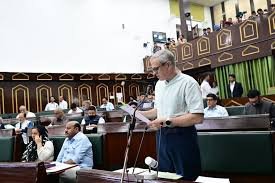
Jammu, March 31, 2026 : Chief Minister Omar Abdullah on Tuesday informed the Assembly that five glacial lakes in the Kashmir Himalaya have been identified as having “very high susceptibility” to Glacial Lake Outburst Floods (GLOFs), though they are not under immediate threat.

Responding to a query by NC MLA Tanvir Sadiq, the Chief Minister said a preliminary geospatial analysis was conducted to map downstream risks, including exposure of habitations and critical infrastructure in districts like Ganderbal, Shopian, and Kulgam.
Lakes Under ‘Very High’ Risk Category
- Bramsar
- Chirsar
- Nundkol
- Gangabal
- Bhagsar
The assessment, conducted by University of Kashmir and published in the Journal of Glaciology, evaluated 155 glacial lakes using hydro-geomorphic indicators such as lake expansion, dam stability, and surrounding terrain conditions.
Potential Impact
The study warns that in the event of a GLOF:
- 2,704 buildings could be affected
- Around 15 major bridges at risk
- Key road infrastructure may be damaged
- At least one hydropower project lies in the potential flood path
A GLOF is a sudden, high-magnitude flood caused by the failure of a glacial lake dam, often triggered by factors like heavy rainfall, avalanches, or ice collapse.
No Immediate Threat, But High Vulnerability
Omar Abdullah clarified that “very high susceptibility” does not indicate an imminent disaster, but signals increased risk under specific triggering conditions. The study serves as a baseline for future risk assessment and planning.
Key Challenges
Experts highlighted that accurate risk estimation remains limited due to lack of bathymetric data (depth and underwater mapping) for most Himalayan lakes. To address this:
- Advanced survey tools, including an RTK-enabled robotic echosounding boat, have been procured with support from the Ministry of Earth Sciences
- Field-based bathymetric surveys are planned for 2026
Mitigation & Preparedness Measures
The government outlined a multi-layered strategy:
- Continuous monitoring via remote sensing & field studies
- Development of early-warning systems
- Ecozonation plans for vulnerable downstream areas
- Integration of GLOF risks into district disaster management frameworks
Researchers are also working on real-time alert systems combining satellite data, sensors, and hydro-meteorological inputs to ensure timely warnings in mountainous regions.