

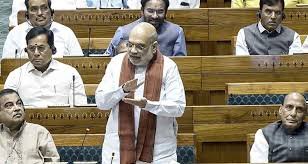
New Delhi, April 16, 2026 : Union Home Minister Amit Shah firmly stated in the Lok Sabha that reservation based solely on religion, particularly for Muslims, is unconstitutional and will not be implemented by the government. He emphasized that the Indian Constitution does not permit quotas on religious grounds, reiterating the government’s clear stance during a heated parliamentary debate.

The discussion followed arguments by Samajwadi Party leaders, including Akhilesh Yadav, who advocated for reservation benefits for Muslims. Responding sharply, Shah clarified that while political parties are free to distribute tickets as they choose, constitutional provisions cannot be altered to allow religion-based reservations.
A major announcement during the session was the confirmation that a caste census will be conducted alongside the ongoing population census. Shah noted that the current houselisting phase does not include caste data but assured that provisions for caste enumeration will be incorporated in the next phase—something he personally supports.
The move aligns with a prior decision taken by the Cabinet Committee on Political Affairs under Prime Minister Narendra Modi to include caste data in the upcoming census—marking a significant policy shift, as caste enumeration has not been part of official census operations since Independence.
Additionally, Parliament took up three crucial legislative proposals:
- Constitution (131st Amendment) Bill, 2026
- Union Territories Laws (Amendment) Bill, 2026
- Delimitation Bill, 2026
One of the most notable proposals includes increasing the strength of the Lok Sabha to 815 seats, with 272 seats reserved for women, ensuring 33% representation.
The developments signal a major shift in India’s political and constitutional landscape, touching upon representation, social equity, and electoral restructuring.