

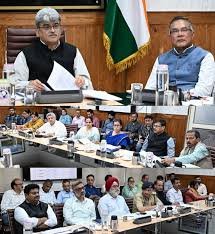
SRINAGAR, May 23, 2026 : Chief Secretary Atal Dulloo on Saturday chaired a high-level review meeting of the Transport Department to assess progress on road safety, traffic enforcement, technology integration and implementation of key reforms aimed at reducing road accidents and improving traffic management across Jammu and Kashmir.

The meeting was attended by senior officials including the Additional Chief Secretary, PWD; Principal Secretary, Home; Commissioner Secretaries of Health and Law; Secretary Transport; IGP Traffic; Transport Commissioner; State Informatics Officer (NIC) and other concerned officers.
The review focused on implementation of the recommendations of the Supreme Court Committee on Road Safety (SCCoRS), functioning of road safety mechanisms, PM-RAHAT scheme, electronic monitoring systems and various flagship interventions being undertaken jointly by the Transport Department and allied agencies.
Expressing serious concern over the recent tragic road accident in Udhampur district that claimed around 21 lives, the Chief Secretary directed all Deputy Commissioners to submit comprehensive Annual Action Plans for implementation of SCCoRS recommendations in their respective districts.
He also sought accountability in the Udhampur accident and instructed authorities to furnish detailed accident reports from every district for proper analysis and corrective action.
Reviewing the implementation of the hit-and-run compensation mechanism, Atal Dulloo directed officials to ensure timely disposal of cases and immediate assistance to affected families.
While assessing the functioning of the e-Challaning system, the Chief Secretary ordered concerned departments to identify and remove all bottlenecks hampering its effective implementation. He emphasized that technology-driven enforcement must function efficiently to improve transparency, accountability and compliance with traffic rules.
The Chief Secretary further asked authorities to examine the feasibility of creating a separate fund head within the Public Works Department (PWD) for rectification of accident-prone blackspots and hotspots across the road network.
He also directed agencies including BRO, NHAI and NHIDCL to earmark dedicated resources for roads maintained by them and undertake corrective measures in mission mode. Stressing safer public transport operations, he called for development of passenger zones and designated stopping areas wherever feasible.
Taking strong note of traffic congestion caused by encroachments in urban areas, Dulloo directed the Jammu Municipal Corporation (JMC) and Srinagar Municipal Corporation (SMC) to intensify anti-encroachment drives in both cities for smoother traffic movement and enhanced pedestrian safety.
The meeting also reviewed safety measures related to school transportation. The Chief Secretary directed authorities to conduct a comprehensive audit of school buses to ensure strict adherence to prescribed safety norms and operational standards.
Reviewing trauma care facilities across the Union Territory, he instructed the Health Department to examine upgradation of services in Government Medical Colleges for establishment of robust trauma and critical care systems.
He emphasized that specialized services including Orthopaedics, Neurosurgery and Anaesthesia must remain available round the clock in these institutions and directed the department to submit a suitable proposal besides ensuring timely completion of all Critical Care Blocks being established across Jammu and Kashmir.
Regarding implementation of the e-DAR and e-Court portals, the Chief Secretary directed the Information Technology Department to take up the matter with NIC and the Ministry of Road Transport and Highways for making these systems operational in Jammu and Kashmir on the lines of Delhi and Karnataka.
Stressing scientific road safety management, he also called for extensive stakeholder training under the i-RAD system and comprehensive road audits across the Union Territory to identify deficiencies and implement timely remedial measures.
Secretary Transport Avny Lavasa informed the meeting that the J&K Road Safety Policy-2025 has already been notified and a detailed Road Safety Action Plan Matrix prepared with defined timelines and responsibilities for different departments.
She said the action plan includes blackspot rectification, strengthening of traffic control systems, road safety audits, bus route restructuring, parking policy implementation, installation of crash barriers and scientific traffic calming measures.
The meeting was informed that district-level road safety committees have intensified their functioning, with the number of meetings increasing from 18 till March this year to 35 meetings conducted by mid-May across Jammu and Kashmir.
Transport Commissioner Vishesh Paul informed the meeting that under the Road Accident Victim Fund, Rs 1226.10 lakh had been received so far, out of which Rs 1218.10 lakh was released to districts for assistance to accident victims and their families.
He added that under the hit-and-run compensation mechanism, financial assistance is being provided as per Government of India guidelines and cases are being regularly monitored by district administrations.
Reviewing enforcement measures, officials informed the meeting that e-Challan systems integrated with Instant Payment Gateway (IPG) have been implemented across the Union Territory, enabling fully digital enforcement by the Motor Vehicles Department and Traffic Police.
The department reported a significant increase in enforcement activities over the past three years, including seizure of vehicles, suspension of driving licences, blacklisting of vehicles, cancellation of registration certificates and cancellation of route permits against violators.
The Chief Secretary also reviewed the operational status of Integrated Traffic Management Systems (ITMS) in Jammu and Srinagar.
Officials informed the meeting that all ITMS equipment in Jammu has been fully operational since June 2024, while Srinagar ITMS became fully functional after resolution of initial technical issues. Hundreds of ANPR, RLVD, PTZ and surveillance cameras have been installed to strengthen electronic monitoring and automated enforcement.
According to officials, over 5.34 lakh challans have been issued through ITMS Jammu since June 2024, while more than 60,000 challans have been generated through Srinagar ITMS since December 2024, leading to substantial fine realization and improved enforcement coverage.
The meeting also reviewed capacity-building initiatives under the i-RAD programme. Officials informed that extensive training programmes had been conducted for stakeholders from Police, Health and Public Works departments to ensure timely and accurate data entry on the i-RAD portal for improved accident analysis and future planning.
Reiterating the administration’s commitment towards safer roads and efficient mobility, the Chief Secretary called for close coordination among all departments and agencies to ensure effective implementation of road safety initiatives and reduction in accident fatalities across Jammu and Kashmir.