


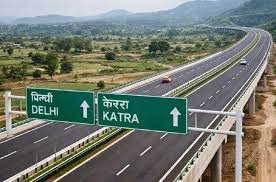
Jammu, June 17, 2026 : The much-anticipated 143-kilometre stretch of the Delhi–Amritsar–Katra Expressway in Jammu and Kashmir is expected to be completed by August 2027, marking a significant milestone in the region’s rapidly expanding road infrastructure network.

Union Minister of State for Road Transport and Highways, Ajay Tamta, reviewed the progress of the expressway and several other key infrastructure projects during an extensive visit to the Union Territory.
Officials informed the Minister that the 670-km Delhi–Amritsar–Katra Greenfield Expressway, being developed at an estimated cost of ₹41,000 crore, will substantially enhance pilgrimage, tourism, and regional connectivity. The 143-km Jammu and Kashmir section, costing around ₹11,500 crore, is expected to reduce the Delhi–Katra distance by nearly 58 kilometres, making travel faster and more convenient for pilgrims and tourists.
During his visit, Tamta inspected the entire Srinagar–Jammu section of National Highway-44, including the strategically important Qazigund–Banihal and Chenani–Nashri tunnels, the landslide-prone Ramban–Banihal stretch, and the ongoing Jammu and Srinagar Ring Road projects being executed by the National Highways Authority of India (NHAI).
The Minister also reviewed the Chenani–Sudhmahadev road project and the proposed Sudhmahadev–Dranga Tunnel, being developed by the National Highways and Infrastructure Development Corporation Limited (NHIDCL). Senior officials from NHAI, NHIDCL, the Border Roads Organisation (BRO), the Public Works Department (PWD), and the Ministry of Road Transport and Highways accompanied him during the inspections.
Highlighting the scale of infrastructure development since 2014, Tamta stated that Jammu and Kashmir has witnessed unprecedented growth in road and transport connectivity. He noted that projects worth nearly ₹1.35 lakh crore have been undertaken across the Union Territory. Of these, 700 kilometres of roads worth ₹20,000 crore have already been completed, while 2,300 kilometres worth ₹50,000 crore are currently under construction. Detailed Project Reports (DPRs) for an additional 707 kilometres of road projects worth ₹65,000 crore are also being prepared.
Tunnel construction has emerged as a major focus area in the region. While only five tunnels existed before 2014, the Jammu–Srinagar corridor now features 25 tunnels, including 20 completed projects and five currently under construction. Strategic projects such as the Zojila Tunnel, Digdol–Khooni Nallah, Sungal Tunnel, Bhimber Gali Tunnel, Sinthan Pass Tunnel, Sudhmahadev Tunnel, Sadhna Pass Tunnel, Peer Ki Gali Tunnel, and the parallel Chenani–Nashri alignment are expected to ensure seamless all-weather connectivity.
Officials further informed the Minister that the ₹16,000-crore Jammu–Udhampur–Srinagar four-lane corridor has achieved nearly 95 percent completion. Once fully operational, the corridor will reduce travel time between Jammu and Srinagar from approximately nine hours to nearly four hours, while shortening the route by around 70 kilometres. Modern tunnels, viaducts, bypasses, and advanced landslide protection measures are transforming NH-44 into a safer and more reliable highway.
To strengthen road resilience, improvement works worth ₹230 crore are underway at 15 vulnerable locations between Udhampur and Banihal. Additionally, bypass projects valued at ₹600 crore have already been completed at Banihal, Ramban, Ashajipora, Seri, and Makarkote.
Urban mobility is also receiving a major boost through ring road projects. The 104-km Srinagar Ring Road, being developed at a cost of ₹7,200 crore, will help divert through traffic from Srinagar city and improve connectivity to Baramulla, Kupwara, Bandipora, Gurez, Kargil, and Leh. Meanwhile, the 58-km Jammu Ring Road is nearing completion, with 53 kilometres already operational, while DPR preparation is underway for the proposed 33-km Eastern Jammu Ring Road.
In preparation for future tourism and pilgrimage demands, DPRs are being prepared for 60 kilometres of road infrastructure related to the Amarnath Yatra, estimated to cost ₹3,500 crore. The upcoming ₹880-crore Katra Intermodal Station will integrate rail, road, and helicopter services, providing seamless transportation for pilgrims visiting the revered Vaishno Devi shrine.
Furthermore, officials revealed that 54 ropeway proposals worth ₹30,000 crore have been received, with eight priority projects valued at ₹16,000 crore proposed in the first phase. These ropeways are planned for prominent destinations, including the Amarnath Cave Shrine, Shankaracharya Temple, Thajiwas Glacier, Bhadarwah, Sanasar, and Doodhpathri, aiming to strengthen tourism infrastructure and improve accessibility across Jammu and Kashmir.
The ongoing infrastructure push is expected to transform connectivity, boost tourism, facilitate trade, and contribute significantly to the socio-economic development of the Union Territory in the coming years.