

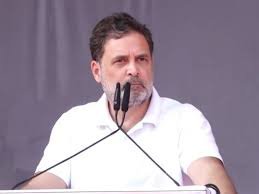
New Delhi, June 17, 2026 : Congress leader Rahul Gandhi on Wednesday sharply criticized the Central Government’s decision to temporarily restrict access to the messaging platform Telegram ahead of the NEET-UG 2026 re-examination, alleging that the move targets students rather than those responsible for examination paper leaks.

Taking to social media platform X, Gandhi described the temporary ban as a misplaced response to a deeper systemic problem, arguing that the government should focus on dismantling organized paper leak networks instead of restricting access to a platform widely used by students.
Calling the measure a “new trick” by the government, Gandhi remarked that it was equivalent to “putting a lock on the victim’s house instead of catching the thief.”
He pointed out that millions of students across the country have relied on Telegram for years to access study materials, notes, test series, educational discussions, and exam preparation resources.
“Lakhs of students have been studying on Telegram for years. How does taking away that facility become a solution to paper leaks?” Gandhi questioned.
The Congress leader further argued that the restriction was unlikely to be effective in curbing malpractice, noting that users could still access the platform through Virtual Private Networks (VPNs) and that those involved in illegal activities could easily shift to alternative communication channels.
Raising concerns over what he termed excessive focus on symbolic measures, Gandhi said that while authorities may introduce stringent examination-day protocols, such steps would fail to address the root cause unless action is taken against organized paper leak syndicates.
“On exam day, students will be frisked, pockets checked, and elaborate security measures deployed. But there is no strike at the root of the disease. The paper leak mafia continues to thrive while students suffer,” he said.
Urging Prime Minister Narendra Modi to adopt a tougher stance against those responsible for examination fraud, Gandhi stated, “Drop the theatrics. Strike at the mafia, not the students.”
He also warned that continued neglect of student concerns could trigger a stronger response from the country’s youth, asserting that students are increasingly aware of their rights and expectations from the education system.
The remarks came a day after the Government temporarily restricted access to Telegram across India ahead of the NEET-UG 2026 re-examination scheduled for June 21.
The National Testing Agency (NTA) defended the move, stating that the temporary restriction, effective until June 22, was aimed at preventing the spread of leaked examination materials, misinformation, and cheating-related communications.
NTA Director General Abhishek Singh said the agency was taking every possible precaution to ensure a fair and transparent examination process.
“We will not let anything go wrong. Every necessary measure is being taken to ensure the examination is conducted without malpractice,” Singh said.
The restriction has led to Telegram being removed from major app distribution platforms in India. Google delisted the application from its Play Store, while Apple also removed it from the App Store in compliance with the Government’s directive. Existing users have reported difficulty accessing the platform without VPN services.
Meanwhile, Telegram CEO Pavel Durov also criticized the temporary ban, describing it as a measure that impacts millions of ordinary users rather than those responsible for leaking examination papers.
According to Durov, restricting access to the platform does little to prevent organized malpractice, as those involved can easily migrate to other applications while genuine users lose access to important communication and educational resources.
The controversy has reignited the broader debate over balancing examination security with digital access, particularly as concerns over paper leaks and examination integrity continue to dominate discussions surrounding competitive examinations in India.